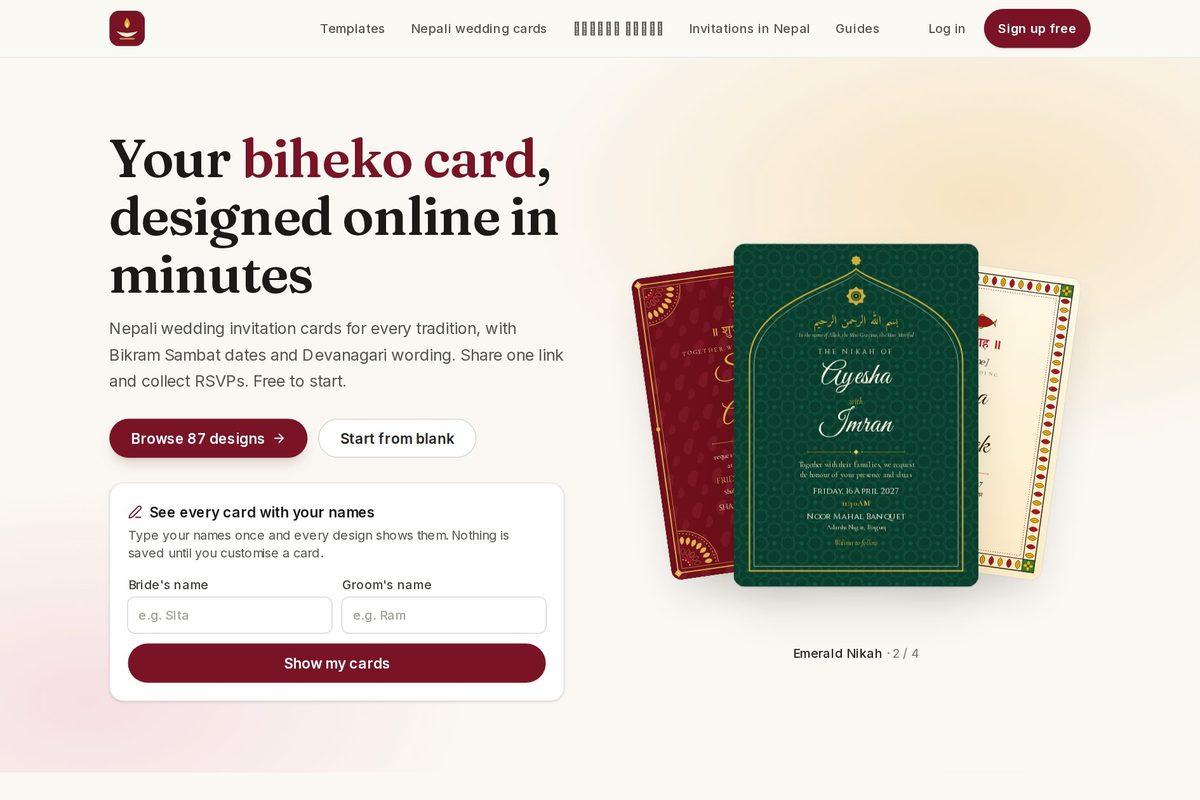
Every Nepali wedding season produces the same small crisis. The family agrees the wording, the printer sends a proof, someone notices the tithi is wrong or the venue has changed, and by then a few hundred cards are already printed or a flat JPEG is already circulating in family Viber groups. Bihekocard is our answer to that: an online biheko card maker where a couple designs the invitation in the browser, sends one link, and collects RSVPs in one place. This post covers why we built it and the decisions that shaped it.
The problem with a picture of a card
Most Nepali invitations that are sent digitally today are an image of a printed card. That works until something changes. A typo, a new venue, a shifted saait or an extra ceremony means making a new image and hoping everyone sees the latest one rather than the first one. A picture also tells you nothing about who is coming, so the couple ends up counting replies across a dozen chat threads.
The online card makers that do exist are built for Western weddings. They assume a Gregorian date, English wording and a single event. A Nepali card needs the Bikram Sambat date, Nepali weekday names, the tithi in Devanagari numerals, and often several ceremonies with their own times and venues. It also needs to look like it belongs to the family's own tradition, not like a template made for somewhere else.
What Bihekocard does
- 87 designs across traditions. Hindu, Buddhist, Muslim Nikah, Christian and Sikh formats, with art drawn from Newar, Mithila, Marwari, Tharu and Kirat styles, including multi-page booklets. There is also a blank canvas for families who want to start from nothing.
- Type your names once. Every design previews with the couple's real names and details, so choosing a card means comparing finished results rather than placeholder text.
- The Nepali calendar by default. The date is entered once in Bikram Sambat or AD, and the card shows both, with Nepali weekdays and the tithi in Devanagari numerals.
- Each ceremony its own time and venue. Every ceremony on the card can carry its own time and venue, with tap-for-directions for guests.
- One link that keeps working. Guests open the card on WhatsApp, Viber or Messenger with no app to install. A correction after sending updates the same link, so nobody is left holding an outdated version.
- RSVPs in a dashboard. Replies land in the couple's account instead of being scattered across messages.
- More than weddings. The same editor handles bratabandha, pasni, engagements, birthdays, anniversaries, housewarmings, festivals and parties.
The flow: four steps, no phone call
The whole product is built around one short path: pick a design, add names and dates, share the link, collect RSVPs. We treated anything that added a step to that path as a cost that had to justify itself. There is no sales call, no waiting for a designer to send a proof, and no app for guests. A couple can go from an idea to a card in their relatives' inboxes in one sitting, which matters when the wedding date is closer than anyone would like.
The detail generic tools get wrong is the one a Nepali family checks first. So we made it the default rather than an option.
Getting the calendar right
The Nepali calendar was the part we were most careful with, because it is where a card loses credibility instantly. An elder will read the Bikram Sambat date and the tithi before anything else. Converting between BS and AD, printing weekdays in Nepali and rendering numerals in Devanagari all happen automatically from a single date input, so the couple cannot accidentally print two dates that disagree. It is the kind of work that is invisible when it is right, and the reason we spent time on it is that everyone notices when it is wrong.
Built to be found
A product like this lives or dies on search, because couples do not know it exists until they go looking. Bihekocard is built with Next.js and React, server-rendered and prerendered so that every template, category and guide page is a real, indexable page in both English and Nepali. That lets it rank for the searches people actually type, from "Nepali wedding cards" to "बिहेको कार्ड". Pages are light and fast on a mid-range phone on mobile data, which is how most guests will open the link. The approach is the same one we describe in Core Web Vitals and SEO and the technical SEO audit checklist.
What we learned building it
- Local detail is the product. The features that make Bihekocard useful are not clever technology. They are the calendar, the wording, the traditions and the sharing channels Nepali families already use.
- A link beats a file. Moving from an image to a living page solved corrections, directions and RSVPs at once.
- Real previews sell the design. Showing every template with the couple's own names made choosing faster than any filter we tried.
- Self-serve has to mean self-serve. If a couple needs to message us to finish their card, the flow has failed, so the editor is designed for people who have never used a design tool.
Try it, or build something like it
If you are planning a wedding, a bratabandha or a pasni, you can make a card at bihekocard.com. If you are interested in how the build came together, the full Bihekocard case study covers the challenge, approach and what was delivered. And if you have an idea for a product built around something specifically Nepali, that is exactly the kind of work our software development and UI/UX design teams enjoy, and we are happy to talk it through.
Abishek Bimali
Founder & Engineer
Abishek founded SiteCraft Innovation and leads its engineering. He writes about building web and mobile products that hold up in production, for teams in Nepal and abroad.